|
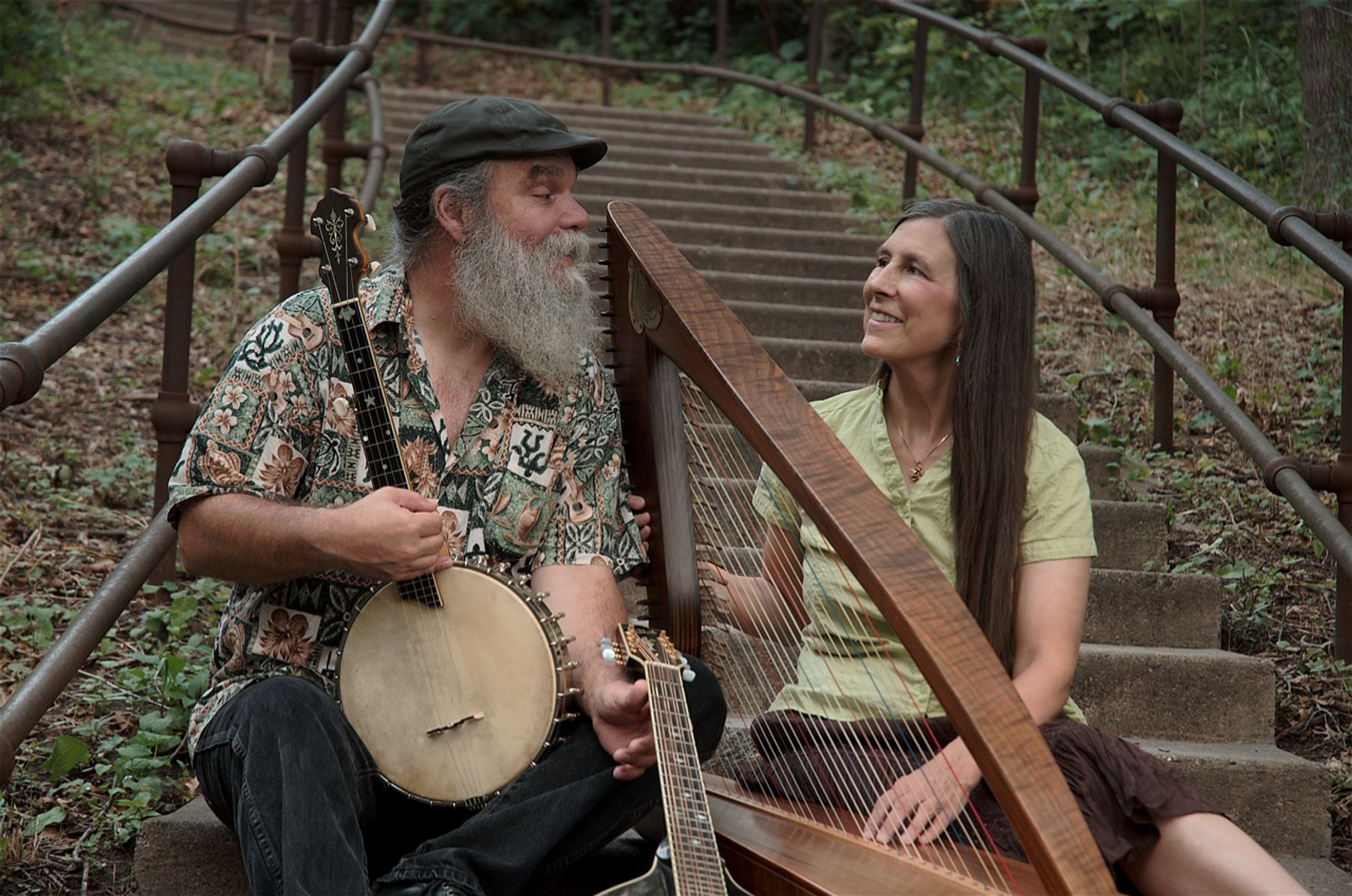
Curtis & Loretta's music comes straight from the heart. The husband and wife duo's extraordinary harmonies and proficiency on a parade of stringed instruments create an alluring frame for their poignant original songs, and carefully chosen traditional pieces from the British Isles, America, and beyond. The current menagerie includes Celtic harp, mandocello, mandolin, guitars, clawhammer banjo, and National steel ukulele, plus a bit of kazoo, harmonica, and shakers.
They were married (to each other!) 24 years ago, in Santiago, Mexico. Ten years earlier, in the spring of 1977, they had chanced to meet each other on the beach just outside Santa Cruz, California. Their best guesstimate of the actual day is sometime in April. Love was born, a duo was formed, and they took to the road, hitchhiking up and down the West Coast, playing in cafes, and on the street. Over the next three decades, Curtis Teague and Loretta Simonet's harmonies have gotten tighter than ever, their stage presence has blossomed, and they've graduated from the street to dedicated audiences across the U.S. From the Cedar Cultural Center in Minneapolis to Fiddling Cricket Concerts in San Jose, from the Folk Club of South Florida in Miami to the Fox Valley Folk Festival in Chicago, and innumerable places in between, they've racked up countless miles over the years, crisscrossing the country to deliver their own unique brand of folk singer/songwriter music. They've played at folk festivals, folk clubs, concerts, universities, on national and regional public radio, and on national cable television. They've shared billings with Arlo Guthrie, Pete Seeger, Jez Lowe, Greg Brown, Anne Hills, Bill Staines, Holly Near, Tanya Savory, and Vassar Clements, to name just a few. In 2000, they were honored to be included on a National Public Radio holiday special hosted by Judy Collins, "Do You Hear What I Hear: A Holiday Folk Tour." Their heartfelt original songs have won them fans throughout the U.S. and overseas. Curtis & Loretta revel in writing songs about the heroism and integrity of real-life, ordinary people, often people they actually know. "Angel of Bergen-Belsen" is the story of Luba Tryszynska, a holocaust survivor who saved 54 children during World War II. Curtis & Loretta sought her out and met her after writing the song, and became good friends with this legendary woman. Luba invited them to visit, and they stayed with her at her home in Miami four times. They also kept in contact with Luba by phone for many years, until she passed away in 2009. The title cut on "Gone Forever" tells the heart wrenching story of Loretta coming to terms with her dad's Alzheimer's. "Elza and Branko (The Siege of Sarajevo)" details the love and bravery of a couple living through the Balkan wars. Curtis & Loretta located Elza, who had since been widowed, and stayed in contact with her for many years. Curtis & Loretta live and breathe folk music. It's not something they put away at the end of the day, not something they ever want to "retire from." It's woven inextricably into their lives. Rick Mason wrote in the Minneapolis City Pages A-List, "There's something about the charming local folk duo Curtis & Loretta that transcends their talents on a variety of stringed instruments, their finely interwoven vocal harmonies, and their ability to make traditional folk tunes -- mostly from the British Isles -- shimmer with fresh vitality. That secret ingredient is at the core of Loretta's songwriting (Curtis ain't no slouch on that score either.) With a journalist's eye for detail and a knack for tugging at heartstrings while cutting to the quick of an issue, she writes riveting songs..." And though it's not commonly known, folksingers do want to have fun! The duo's perennial humor shines through, with songs of harp players trying to get into heaven, small spenders on first dates, bugs, and lutefisk! They received an Arts Tour Minnesota grant in 2010, from the Minnesota State Arts Board, on the strength of their latest CD, "Our Heritage in Song," presenting 19 historical concerts throughout their home state. In 2002, Minneapolis entertainment paper City Pages named them "Best Acoustic Performer of the Twin Cities." They've received numerous Minnesota Music Award nominations for Best Acoustic Folk Artist. In 2006, Curtis & Loretta made the "Top Artists of 2006" list on www.folkradio.org (folkdj list). That same year, their album, "Just My Heart For You" was on the "Top Albums of 2006" on that site, and "Gone Forever" was on the list for "Top Albums of 1999." Curtis TeagueCurtis grew up in Duncanville, near Dallas, Texas. He learned to sing harmony alongside his mother in the small family church (his dad and grandfather took turns preaching each Sunday). When the family acquired a record player from an uncle, it came with three albums; Perry Como, Bing Crosby, and Pete Seeger. Curtis chose Pete, and his musical influences have tended that way ever since. He bought a guitar from the want ads when he was 12, and his parents lamented he'd never be able to learn to play it. Of course, that only made him more determined.
He ran away from home at 15, and lived in Hawaii for five years. He spent most of his time there as a beach minstrel/bum/tree house dweller. He studied shakuhachi (Japanese meditation flute), and learned to body surf and sail. He ended up crewing on an antique 60 foot ketch from Honolulu to San Francisco, a 30 day crossing. Back on the mainland, he continued studying shakuhachi with his teacher Peter Ross, who had moved to Santa Cruz, California. Curtis also apprenticed as a shakuhachi builder with Peter. And he joined the incredible street music scene on the mall in Santa Cruz in the late seventies, along with such soon-to-be luminaries as Bob Brozman, Artis the Spoonman, and The Flying Karamazov Brothers. Curtis has developed his own unique, self-taught style on several stringed instruments. After guitar, he taught himself how to play banjo, then mandolin, which logically led to mandocello and mandola. His latest love is ukulele. "Teague is the master of a host of instruments, including guitar, mandocello, ukulele, and clawhammer banjo," says the Express-Times of Bethlehem, Pennsylvania. And his full rich voice is an integral part of the duo's harmonies, whether they're singing their originals, or traditional songs. Loretta SimonetBack while Curtis was sweltering in the Texas heat, Loretta Simonet was growing up north of there, in the historic river town of Stillwater, which is the birthplace of Minnesota. She grew up loving the stage (any stage!), singing and putting on puppet shows in the basement, and taking piano lessons. At 12, she taught herself to play guitar from a Peter Paul and Mary songbook, so she could play in the teen choir at church. P.P.M. were one of her first loves in folk music, along with Joni Mitchell, Judy Collins, and Michael Johnson.
She acted in high school plays, and sang in concert choir, then went to St. Cloud State University in Minnesota. She spent all her time in the performing arts building, singing in concert choir, acting in plays, building sets and sewing costumes. She did summer stock for two years, and graduated with a Bachelor of Arts degree in Theatre. Curtis says Loretta is a natural born singer. She's developed her voice into a pure, rich instrument. She studied voice for several years with Jeanie Brindley-Barnett. Though she has been compared to the likes of legends Joan Baez and Kate Wolf, the truth is that her distinctive voice sounds like no one else's. City Pages called Loretta's voice "compelling and crystalline," and Jon Bream of the Minneapolis Star Tribune says, Loretta Simonet has a jewel of a voice." Self-taught on guitar and mandolin, her hands found their true home on folk harp in 1988. She soon discovered that harp was the instrument she was "meant to play," and decided she would seek out a teacher for this very special endeavor. She has studied harp with Gaylord Stauffer, and Bridgett Stuckey, harpist for the St. Paul Chamber Orchestra. Curtis Picks Loretta Up On BeachAfter graduating, Loretta headed to the West Coast to pursue her dream of performing, either in folk music or theatre. She did some acting in community theatre and sang in a variety show. To bolster that meager income, she was working as a nurse's aide in Santa Cruz in 1977 when she went to the beach one day, guitar in hand, to practice for that night's variety show. A young man walked up to her with the age-old line, "Hey, I play guitar!" It was Curtis, just back from Hawaii. Loretta had heard that line before, often from guys who didn't know a fret from a flatpick. But this guy was different. He ran home and returned a few minutes later with a mandolin. The two sat down on a log and started jamming and even with that first song, the harmonies surprised them both. Their voices fit together so effortlessly. Loretta invited Curtis to sit in at her gig that night. Soon she quit her nursing home job and joined him at his "gig," playing music on the street. A few months later, they were hitchhiking up and down the West Coast, playing at coffeehouses and cafes. They picked apples and pears to help make ends meet in Washington. They backpacked through Europe for six months, busking on the streets and in subways, and picking tulips in Holland when they ran out of money. Eventually they ended up back in Minneapolis. The first songs they performed together were sixties folk songs (they think that first one on the beach was Leonard Cohen's "Suzanne"). In the eighties they found themselves drawn to Celtic music, especially when Loretta started playing harp. An exciting step in the evolution of their music was starting to write their own songs. The duo's originals are absolutely influenced by their traditional background, but they're not afraid to tackle tough, contemporary issues. Rick Mason (City Pages A-List) said, "Loretta's remarkable originals ... are often certifiable tearjerkers, tackling, for instance, the ravages of Alzheimer's and the story of a concentration camp heroine. Loretta pulls it off by sidestepping melodrama in favor of eloquent writing and clear-eyed journalistic detail. It's both musically riveting and spiritually invigorating." Between the duo's gigs at local and regional folk clubs and festivals, writing songs, and learning new instruments, the couple found creative ways to supplement their music income. Curtis earned a degree in Musical Stringed Instrument Repair at Red Wing Technical College in Minnesota. It's one of a few such accredited classes in the country. He has built a national reputation for identifying and dating rare vintage pieces. Loretta built a cottage industry making and selling glass beaded jewelry at Renaissance Faires across the country while Curtis repaired instruments at local music stores. In 1987, they were married in Santiago, Mexico (near Manzanillo). They Hit the Road Again (and Again)In the Nineties, their love for the music and performing drew them back to the road. They hit the road in full force (this time in a mini-van, not hitchhiking!), giving up the beads and instrument repairs to tour extensively in the Midwest, and since the mid-nineties, from coast to coast across the U.S. The duo that started out playing for tips on the street in Santa Cruz now performs full-time, thankful to be making their living doing what they truly love. An evening with Curtis & Loretta is a captivating experience. It runs the gamut of rolling with laughter, to holding back tears, with plenty of side trips in between. Their thought-provoking originals and timeless traditional songs are seamlessly woven together by their tight harmonies and their array of stringed instruments. And their years of performing and touring together have honed their comfortable stage presence to a delightful edge. Recordings:
Last updated January 31, 2011
|